Welcome!

• INTRO POST • FAQ's • MY STORY • POST DIRECTORY • TWITTER • PINTEREST • TUMBLR •
Showing posts with label Henshaws. Show all posts

Thursday, 16 July 2015

Henshaws Summer Appeal 2015


Henshaws, a charity I volunteer for weekly and have been a service user of for over 2 years, have recently launched their Summer Appeal; complete with new branding, as seen on their website, social media accounts and in their new mailings to fundraisers and supporters, which features photos by yours truly from my recent photo session! 

As part of the Summer Appeal, I recount how before becoming a service user I would barely leave the house, after leaving high school and losing more of my vision to the point of near blindness, and felt like my life was over. Henshaws helped me to meet new people in the same position as myself, make the most out of the accessible technology that is available today and learn daily living skills around mobility and cooking.


They have had a huge hand in improving my confidence, independence and my sense of self-worth to go beyond expectations. I am now planning to return to my art and illustration this September by going to the Leeds College of Art; and this is something I would never have dreamed of doing before going to the Henshaws Resource Centre in Old Trafford. After having a huge lack of support the first time I went to college I was put off going back into further education for the longest time, but with completing the Skillstep course last summer I was given the reassurance I needed that going to college was the next logical step in my journey!

You can donate to Henshaws on their website, either by giving £5, £10, £15 or an amount of your choice. I recorded a "thank you" video with my Guide Dog, Tami, which is e-mailed to donors by way of a personal thank you for helping to improve the lives of many people like me in the North of England.

Wednesday, 27 May 2015

New Henshaws Photos!

Here is a selection of photos from my newest photo session with Henshaws Society for Blind People. It was lovely to be able to represent Henshaws again as a service user and volunteer; this time with my Guide Dog, Tami, by my side!


Photos © Gwen Riley Jones

Thursday, 30 April 2015

Eastern Exchanges Exhibition at Manchester Art Gallery


I recently visited Manchester Art Gallery, with the Art Galleries and Museums group from Henshaws, for an audio described talk and tour of the newly-opened Eastern Exchanges: East Asian Craft and Design exhibition. This show creates a fantastic platform in order to display Manchester's historic collection for the first time in over 30 years!

The exhibition boasts over 1,500 years of the rich craft heritage of China, Japan and Korea, including works of ceramics, metalwork, furniture, lacquer, textiles and sculpture. Exhibits range from historical court treasures to modern pieces by contemporary art makers. While there is some overlapping of styles each country developed its own distinctive forms and specialities. These national craft traditions are sources of pride and identity, with highly specialised skills being perfected and used over generations to create such luxury objects.

Audio description was provided by Anne Hornsby, of Mind's Eye Description Services, with additional detailed talks provided by curator Janet Boston. The collection is supported by The Korea Foundation and The Great Britain Sasakawa Foundation, and sponsored by Kuoni and Shangri-La. Our visit was arranged and organised by Meg Parnell, Lifelong Learning Manager.


Eastern Exchanges is divided into 3 sections; with the first area focusing around items that are 'Distinctively Asian'. The majority of pieces here belong to the aforementioned historical court treasures. The first item we were audio described was that of a Japanese Norimon (also known as a Sedan Chair) made from beautiful black lacquer and decorated with intricate gold patterned detailing of flowers and leaves. The Sedan Chair was exclusive to royalty as their way of transport, with 2 or 3 men at either side carrying it at arm's length. The Japanese borrowed the concept of lacquer-making from China, developing and perfecting it even further, eventually becoming the frontrunners of beautiful lacquer items sold worldwide.

The second items we were introduced to, still among the court treasures, were two exquisite embroidered Imperial robes; one of the garments belonging to the Chinese Emperor himself and the other to his son, the Prince. Despite being extremely expensive and taking over 2 years of strenuous embroidery work, focused on the intricate elements of flowers, waves and dragons, they weren't even cut out of their original material and sewn together to wear! This really highlights the extravagance and wealth of the Royal Family at that time.


The next area consisted of more modern contemporary pieces, mostly furniture and decorative items, aptly named 'East Meets West'. The pieces within this section are hugely influenced by conventional Asian design and incorporate traditional techniques. The main item of interest, towering high above visitors, is the gigantic contemporary piece known as 'Chinese Ladders' by Felicity Ayleiff. Ayleiff herself enlisted the help of the Jingdezhen Experimental Porcelain Factory Nº2, a site of Imperial kilns with centuries of experience in firing large-scale ceramics, to create her own series of enormous works.

'Chinese Ladders' was created by using a technique called luting. This is created by joining together hardened clay structures with liquid clay, more commonly referred to as slip. The stacked form took great inspiration from bamboo scaffolding seen in building sites across China and integrates heavy strokes of traditional Chinese brush painting.


'Weave Stool' by Fumio Enomoto, commissioned by the award-winning designer specially for the Eastern Exchanges exhibition, incorporates aspects of functional with comfortable whilst still being of modern design. It is made entirely from bamboo and is a direct replica of its original. Bamboo is a widespread popular material in East Asia that can be spun, heated, shaped and glazed easily. This particular stool was created by using 12 strips of bamboo, weaved from the centre extending outwards, and was inspired by traditional Japanese bamboo baskets. It won the 2011 Bronze Leaf Award at the International Furniture Design Fair.

During the audio described talk, a thick piece of bamboo was handed around the group to enable us to gain a better understanding of how lightweight and flexible the material truly was. It's a shame we couldn't touch the stool itself to feel the weaved design and its exact pliability, but I appreciated the example we did get to touch.


The final area comprised of modern sculptures, vases and other decorative objects; pulling away from the more-traditional crafting techniques displayed in the previous sections, but still making their mark as Asian masterpieces sitting nicely alongside the other exhibits.

My favourite item of the wntire exhibition was housed in this area - the incredible 'Super Jumbo Nigella Wave' by sculptor Junko Mori. This was truly impossible to audio describe! I did enjoy the different interpretations though, and each provided me with a unique mental image of what it could look like visually. Inspired by the growth of living things, particularly plants and sea creatures, Mori incorporated various metal forms and materials into her sculpture to develop individual petal or leaf shapes that give her work phenomenal character. Each leaf / petal was assembled and welded together to create something that can only be described as 'uncannily organic'. The piece was originally inspired by Nigella, a cottage garden flower, but her work took a different approach and was propelled forward after the Tsunami struck Japan in 2011 - taking it into a more powerful, cataclysmic direction.


'Orb' by Yasuko Sakurai closed the Eastern Exchanges exhibition visit for the group. This piece is an elegant coral-like ceramic form, created by hand using a newly-developed technique by the sculptor herself. It was created using Seto porcelain and, as with Junko Mori's work, gives the impression of something organic and life-like.

After studying in the French pottery town of Liomges, Sakurai discovered her fascination of porcelain and invented the idea of piercing holes into it by amassing tube shapes, building vessels around them and then removing the rubes to create elliptical and rotund gaps within the work. She particularly engages with the idea of using light and shade in her ceramics, so incorporates minimalistic colour and design to interpret this.


I want to say a big thank you, as always, to Mary Gifford of the Art Galleries & Museums group for arranging the visit; it is always a pleasure to attend, and the exhibitions inspire my illustration work massively. Also thanks to my sighted guide, Mary Tantrum, who helped me to take the photographs and for taking me to the exhibition, to Janet Boston for the informative talk and tour, to Meg Purnell for organising the visit and to Anne Hornsby for her captivating audio description.

Thursday, 9 April 2015

Interview on Salford City Radio


Yesterday I visited my local radio station, Salford City Radio (94.4FM), during Howard Copitch's Wednesday lunchtime show to talk about my sight loss story of losing my vision at a very young age and reveal how the Henshaws Society for Blind People charity has made a huge difference to my life over the past two years.

I've previously had media training with Chris Brophy, Co-Founder and previous Manager of the station, so was very excited to utilise the skills I learned last year as well as share my story and inform local listeners of how Henshaws can help aid and assist them through a variety of different ways; either by one-to-one skills building, peer support groups and skills based courses. Support is specially tailored to each individual to help them overcome their impairment and achieve their potential.

Mark Belcher, Community Services Manager at Henshaws, joined me in listing some of the various different groups and detailing the Pathway to Independence and how it can help those new to sight loss or new to receiving support. The confidence and independence I have today is a complete result of the Pathway and being on the radio was a fantastic way to platform the success it can give to someone.

Howard was very interested in Tami (of course!) and I was more than happy to tell Salford City Radio listeners of our partnership, how we were matched and the things we get up to on a daily basis!

Unfortunately there wasn't a livestream available at the time so I don't have a podcast to share, but I enjoyed my time on the show immensely (I even got to request a song - Duran Duran's 'Hungry Like the Wolf', if you're wondering!) and would like to say thank you to the Henshaws Marketing Team, Salford City Radio and Howard Copitch for the interview opportunity. I really enjoyed being in a radio station environment and it's certainly something I would love to do more of in the future!

Tuesday, 7 April 2015

Being Safe Online Module
at Henshaws Manchester


Today I attended a new session at the Henshaws Manchester resource centre, called 'Being Safe Online', a module as part of the newly-established TechTalk group that I'm a member of and partake in each month. This was the second time that the session has been delivered through Henshaws and I enjoyed it so much that I wanted to tell you more about some of the topics we covered.

Being online is an amazing experience especially for visually impaired and blind people today, with the accessible technology that is currently available and is still being developed and improved every single day. The dangers of being online are rarely ever discussed when talking about the online experience though, and that is what the session strived to highlight and explore with blind and visually impaired service users. While a lot can be gained by venturing into the digital landscape, there are many negative aspects to be aware of too.

The session began with the group identifying some of the most popular icons of websites that are frequently used on the internet like Facebook, Twitter, YouTube, Amazon, Skype, eBay, Google and Wikipedia - all extremely useful tools in their own right which can unfortunately be abused. The tell-tale symbols of each website were described to the group and we had to name their purpose and functions, such as; communicating, shopping, gaining information and entertainment.

We touched upon some of the most common text-speak abbreviations and what they stand for, and I'm proud to say that I knew the majority of them! There were a few I'd never come across before (particularly paw - parents are watching), so that was interesting for me to learn some of the new lingo that wasn't used back in the days of my chatroom use during the early 2000's.

As a group we suggested some of the things that we may come across online (such as on the aforementioned websites) that could possibly ruin someone's positive experience. Cyber-bullying, cyber-stalking, phishing and spamming, trolling, sexting, blackmailing, identity theft, grooming, hacking, malware and viruses, and inappropriate material / attachments were the main dangers that were spotlighted. We then had to match the definitions of each to the correct term in order to gain a better understanding of what they mean and how they can happen to anybody online.

Activities were then explored in smaller groups where situations were provided, either in example e-mails, tweets, chat conversations or Facebook comments, and we had to identify the danger, what the intention was and how it can be avoided (ie: through filtering, blocking, ignoring and / or reporting).

Facebook settings were discussed and the how different levels of privacy setting affect the audience looking at the posts or photos, even in ones where someone else has been tagged, and whether certain bits of information are even needed to be provided on Facebook publicly (like marital status or interested in / looking for - and how these can actually affect the ads on the page thus driving forward a surge of potential hackers, robots and / or trolls as the audience on the page itself). Also be wary of strangers adding you on websites like Facebook or Skype who will have access to your personal information or possibly probe you for it.

Storing passwords and credit card information on shared or public computers was touched upon and highly advised against, and when shopping online using PayPal is a much safer option. The group learned about identifying spammy e-mails with clickable links within them asking for personal details like passwords to be changed or addresses, phone numbers or bank details needing to be updated. Banks will never actually ask for this information via e-mail as there is no need to.

Location services being enabled, either through Google, Facebook and Twitter, was a major concern for the group and it is always best to ensure these are switched off (particularly on a mobile device). Mentioning you are on holiday, or in a different location, publicly on social media to people you do not know or do not trust is also never a good idea!

Towards the end of the session we learned more about ads and popups and how those can be harmful with inappropriate images, especially to minors, and the module was ended on the subject of passwords and how long it takes to crack the varying strengths. The more characters that are used, including uppercase, lowercase and numerical characters, the harder it is for a hacker to crack the code. Using simple, guessable passwords on a multitude of websites can lead straight to the possibility of being hacked, with someone being able to quickly guess the password through information that they can access publicly on your social media accounts (such as birthdate, address or mother's maiden name). This was something that the group really responded to.

It's all about being aware of what people (and the internet) can be capable of and this session was a fantastic introduction to that. Some things are common sense and other things, such as learning about malware, viruses and trojan horses being cleverly disguised within downloadable links or attachments, can be learned.

TechTalk is the newest group at the Henshaws Manchester resource centre, meeting on the first Tuesday of every month, discussing the latest apps, accessible technology and products of interest - as well as sharing general hints and tips

 All levels of ability are welcome and the minutes from each meeting, including useful links to products and services, are shared via e-mail at the end of each session.

Monday, 16 March 2015

Dinner in the Dark event
for Henshaws


I recently attended a 'Dinner in the Dark' event earlier this month, arranged by Emblaze Events based at Manchester Metropolitan University, in support of Henshaws Society for Blind People. The event was held at Revolution in Deansgate Locks and featured an art exhibition, two course meal, live singing, raffle and vodka tasting.

The theme for the evening was that of New York City and included many meticulous details; from little yellow taxis printed on the straws of drinks, to the menu for the evening being designed as a newspaper article from the New York Times!


The art exhibition featured Braille works from one of the students including Braille essays replicated in fine sheets of metal, housed in plinths, and jewellery embossed with Braille letters. Live singing was performed by another of the students, providing a Bluesy and Jazzy New York environment.

The evening began with an introductory cocktail shortly followed by the main course. As this was an insight into what it's like to be blind, blindfolds were essential and long waterproof napkins were also provided for those who may have made a mess! As this is something I am used to, eating with very limited vision, I breezed through my meal and finished rather quickly!


After the main course, it was time for me to give my speech. I opened with an introduction to my sight loss from a very young age and how I discovered Henshaws, talked about how Henshaws have helped me in various ways such as confidence-building, developing independence and learning new skills, and how I now volunteer on a weekly-basis to give back to the charity.

As the night was food-themed I also thought I'd share how visually impaired and blind people, such as myself, prepare and cook meals safely, how we label and identify foods and how we choose our items from the menu when going out for something to eat. I gave an overview of the essential accessibility apps I use on a daily-basis which help me with a wide variety of tasks, and have recently been told that one of the professors at Manchester University, who attended the Dinner in the Dark event, now uses one of those apps in his classes!


My speech was followed with dessert, then the raffle (the prizes included a large Henshaws-themed cookie kindly donated by Millie's Cookies!) with the evening ending with vodka-tasting - comprising of three different flavours to try; maple syrup, lemon meringue and vanilla shortcake.


I had an absolutely wonderful time at the 'Dining in the Dark' evening and would like to say a big thank you to all involved with Emblaze Events, helping to raise funds for Henshaws, and to everyone who came along!

All photos © Emblaze Events

Saturday, 14 March 2015

Upcoming Events:
March - May 2015

Spring is well on its way and I have quite a busy few months ahead which, of course, means the opportunity for more exciting blog posts! Here's what I'll be getting up to in the coming weeks:


Monday, 16th March
30 minute 'equality and diversity' speech and presentation for Cargill; whose staff have been volunteering at Henshaws over the years in a variety of roles from bag-packing to supporting social groups. I was kindly invited to give a presentation on how Henshaws have supported me over the past 2 years and how people can help to support blind or visually impaired employees in the office environment or when out and about.

Tuesday, 24th March
RNIB Group workshop at Judd Street in London, to develop work with children and young people - helping to shape the services that Action and RNIB provide. Parents, children and young people will have the chance to share their experiences. I will be giving a 5 minute speech on the importance of independence and how the Envision campaigning network helped in giving me mine.

Wednesday, 25th March
Visit to Windermere, in the Lake District, to an Action for Blind People event for young people to help present a workshop focused around the Envision campaigning network, that I am currently Co-Chair to. I will discuss how I came up with the name of the network, how it has helped to expand my confidence and independence, develop my interest in Politics and grow my campaigning skills.

Thursday, 26th March
I will be filmed by the Books@Home service, part of Salford Libraries, who deliver audiobooks to me each month free of charge. I enjoy a huge plethora of books and have done so for nearly 2 years now. I will be helping with a short film that will show me receiving and listening to my books, and then give an interview on what the service means to me in terms of accessibility, equality and inclusion. The film will be shared with peers and partners of Salford Libraries to show the importance of the service to those who are visually impaired.

Monday, 30th March
Visit to the University of York to test the accessibility of websites for a student's accessibility study (in the Human-Computer Interaction Research Group). I will be evaluating 6 websites, spending between 40 - 60 minutes on each, using a Mac computer with built-in VoiceOver (my preference!) to undertake regular tests and identify possible problems. 

Thursday, 2nd April
Visit to Madame Tussauds in Blackpool for an accessible hands-on visit of their collection. The staff have kindly arranged a visit for me to have a sighted guide and interactive experience of what they have to offer.

Tuesday, 7th April
'Being Safe Online' module workshop at the Henshaws Resource Centre, in Old Trafford, as part of the TechTalk group. It will be a 70 minute session covering a variety of areas, such as; cyber-bullying, cyber-stalking, trolling, identity theft, sexting, grooming, webcam blackmail and e-mail scams. The session will be interactive with both individual and group discussion and quizzes.

Sunday, 19th April
'Swap With Me' event with First Bus in Bolton, giving the opportunity for blind and partially sighted people to speak directly to bus drivers and staff about their experiences and concerns, as well as the challenges that bus travel can bring. There will also be a session on learning the different types of bus layout, with parked buses in the depot, as well as the chance to sit on the driver's cab and experience things from their point of view. Drivers and staff will be asked to undertake a number of activities including scanning a pass and finding a seat to understand the needs of visually impaired passengers.

Thursday, 23rd April
Visit to the Manchester Art Gallery, with the Henshaws Art Galleries and Meseums group, for an audio described talk and tour of the 'Eastern Exchanges: East Asian Craft and Design' exhibition. The show features over 1,500 years of the rich craft heritage of Japan, Korea and China with exhibits ranging from magnificent court treasures to masterpieces by contemporary makers. It will include historic works from Manchester's collection which have not been exhibited for over 30 years!

Saturday, 9th May
Collection event for Guide Dogs at Tesco Extra in Irlam.

Wednesday, 4 March 2015

Henshaws Annual Review 2013-14


The Henshaws Annual Review for 2013-14 is now available to read online!

I'm featured in the volunteering section helping to give an insight into what it's like to be a Henshaws volunteer, why I decided to donate my time to the charity on a weekly basis and what I get out of the opportunities I receive:

Could you support Henshaws by becoming a Volunteer?


Many volunteers, of all ages, give their time to Henshaws. In fact in 2013-14 we had an amazing 232 active volunteers! We wouldn't be able to run our services without them.

We always need volunteers to help across our services in all our centres. We welcome all levels of experience and in return we offer interesting and rewarding activities, a sense of achievement and fun.

Kim is a service user in our Community Services in Manchester. She started volunteering this year and has supported the Marketing team in a whole host of tasks including writing blog posts and press releases, working on social media, talking at events and doing bucket collections.

"Henshaws has been an amazing support to me and I wanted to give something back, to say thank you for giving me my independence. It makes me feel really positive and optimistic about my future and it's always nice to see other people's generosity. It's also been great to learn new skills, which I'm learning all the time as a volunteer!

I really recommend other people get involved. It's so rewarding, you get to meet lots of new, friendly people and experience many exciting opportunities. I've loved being able to use my writing skills to help out but there are so many different ways you can help, from driving, supporting IT classes and doing sports activities, to running social groups and helping out at events. Just get involved!"

To find out more about our current volunteer opportunities call Christine Turner on 01423 541558, e-mail christine.turner@henshaws.org.uk or go to www.henshaws.org.uk/get-involved/volunteering/

You can read the full Henshaws Annual Review either in PDF or Word formats.

Monday, 16 February 2015

Something Blue: Wedding Fashions 1914 - 2014

Vintage-inspired modern wedding dress,
made of panels of sheer fabric and white feathers (2010's)

The Art Galleries & Museums group, based at the Henshaws Resource Centre in Manchester, recently visited the Gallery of Costume at Platt Hall, in Rusholme, for the Something Blue: Wedding Fashions 1914 - 2014 exhibition.

It boasted a wide variety of different dresses spanning a century, each being a perfect representation of the bridal fashion during its associated time period, with a tour and talk provided by Andrew Hunt and with audio description provided by Anne Hornsby of Mind's Eye Description Services.

A touch and handling session followed the tour, led by Adam Quinn and Rosie Gnatiuk, with an interactive and intimate approach to certain dresses and accessories; including hats, fascinators, gloves, shoes, and even an enveloped personal invitation from the 1920's!

From the website: "Something Blue explores a hundred years of bridal fashion from the Gallery of Costume's collections. The show illustrates the changes in styles, materials and fashion trends in wedding dresses throughout the century. Many of the dresses in the exhibition have originated from Manchester and the surrounding area."


Gallery

Here are the photos I took during my tour of the exhibition:

Vivienne Westwood Floral Wedding Dress (2010's)

Sale rail black dress from River Island with Bow detail
and cropped cream beaded cardigan (2010's)

Spaghetti strapped floor-length dress with jewelled details
and knotted bow design (2000's)

Vintage-inspired sheer floaty full-length dress with
long, ruffled sleeves and silk bodice (2000's)

Long-sleeved dress with ruffled shoulders
and bow and button accent on back (1990's)

Floor-length sleeveless halter-neck style red dress (1990's)

Long-sleeved floor length dress with train and ribbons (1980's)

Long-sleeved floaty maxi dress with accented
collar, buttons and sleeves (1970's)

Crocheted floral babydoll dress (1960's)
(my personal favourite!)


This has been my favourite exhibition so far with the Art Galleries & Museums group, based at Henshaws. I thoroughly enjoyed the tour and especially loved the handling session, being able to feel how beautifully tactile some of the accessories were.

I also loved hearing of the personal wedding stories behind the bridal gowns and feel very privileged to have had a glimpse into the personal lives and special days of local ladies; both past and present. I'd like to say a big thank you to Mary Gifford, Anne Hornsby, Andrew Hunt, Adam Quinn, Rosie Gnatiuk and Kate Day.

You can find out more about the Art Galleries & Museums group, providing monthly audio-described tours and touch and handling sessions at Manchester's museums, galleries, heritage sites and places of interest, by clicking here.

Sunday, 25 January 2015

Manchester Beer & Cider
Festival 2015


Yesterday, Tami and I attended the final day of the Manchester Beer & Cider Festival 2015, held at the National Cycling Centre (Velodrome) in Manchester, in support of Henshaws Society for Blind People.

I sold programmes and raffle tickets, collected empty beer and cider glasses which added an additional £3 per glass to the total funds raised, and also gave an overview of Henshaws and the services they provide to interested attendees of the festival!


I attended the event last year, again as a volunteer, which helped to raise much-needed funds for Manchester's oldest charity; providing services, support and life skills to other visually impaired and disabled people like me.

I'm sure we've done even better with our fundraising this year, as Tami was the star of the show! She really attracted the crowds, had lots of fusses and even received a small bag of treats from one of the staff members working at the Velodrome!


I want to say a big thank you to everyone who donated to our buckets throughout the 4 day event. You have helped in making a massive difference to those supported by Henshaws!

Friday, 9 January 2015

Transitions Article for
Trafford CIL Newsletter


I was recently contacted to write an article for the Trafford CIL (Centre for Independent Living) newsletter, on the topic of the different transitions throughout life. As a severely sight-impaired person transitions have varied from being easy to very difficult depending on the amount of support I have received at the time - and I was more than happy to share my experiences with other disabled people.

Transitions: Your Stories

This edition we say a big thank you to Kimberley via Henshaws Society for Blind People for kindly sharing her personal experience of transition towards adulthood…

"Transitioning in life can be difficult, both emotionally and physically, presenting new challenges and learning curves. Nothing in life can stay the same and we all have to transition in some way; whether it's from childhood, adolescence and adulthood or further learning to employment or voluntary work. IT can be tough to adapt quickly and to accept sudden or gradual change. Now, imagine what it would be like to go through those important transitional stages whilst losing your sight.


As a young severely sight-impaired person, I have had different experiences when it comes to transitioning into the different phases of my life so far. Some have been welcome changes; others have not been so welcome. All of them have been dependent on the varying amount of support I have received at the time.

The transition from primary school to high school was an easy one; an exciting prospect, as I was still very young and most children tend to adapt to different environments easily. I received the same level of support from teachers and peers as I did previously and I still managed as best as I could and received excellent grades. However, as I grew older and learned more about the extent of my sight condition and other health issues, I developed severe depression and anxiety making later transitions more difficult.

The idea of change suddenly became terrifying. I dreaded the moment I would be leaving the high school I was confident and comfortable in during the previous 5 years. The idea of college provided me with a sense of uncertainty and apprehension. I didn't feel like I belonged because of my visual impairment - which was constantly getting worse. No support had been offered to me thus far and I was too scared to reveal the extent of my condition and the support I desperately needed, in fear of being treated to anyone else. As a sixteen year old I wanted nothing more than to fit in and be perceived as a 'normal' teenager.

After recovering from my other illnesses, and coming to terms with my dwindling vision, I began to accept who I was after being in denial for so long throughout my later teenage years. I have received life-changing support from Henshaws Society for Blind People over the past year and a half in terms of living with sight loss, daily living skills, mobility training, employability guidance and, now, a work placement with the fundraising and marketing team. Being given the opportunity to develop friendships and connect with other visually impaired people for the first time has also increased my confidence and sense of well-being. The combination of learning new skills, being offered constant support and a strong social network has helped me to become who I am today.

Becoming a volunteer and undertaking a work placement has been the easiest transition of all thanks to Henshaws and the wonderful work that they do. I have recently been matched to my Guide Dog and will undergo intense training which will eventually see me lead a more independent life; travelling alone, accessing social opportunities and being a part of the working environment - just like anyone else.

Ten years ago I would have found this to be the most daunting thing I have ever faced. Today I relish in new challenges, feel a strong sense of determination and look forward to my next transition!


You can find out more about the Trafford Centre for Independent Living and the services they offer by visiting their website here.

Saturday, 20 December 2014

Skillstep Accreditation Certificate


I have now received my OpenAwards accreditation certificate for my confidence building work during the Skillstep course, developing personal confidence and self awareness as well as improving assertiveness and decision making. I received 6 credits overall at Level One, with 3 credits in each of the criteria.

Skillstep is a 12 week training course, provided by Henshaws Society for Blind People, and supported by the Big Lottery Fund. It is a practical course and beneficial for those who are seeking employment or voluntary work, or for those wanting to go into further education. Skillstep also delivers the perfect opportunity to boost confidence and independence, and expand social circles.

You can view all of my previous Skillstep posts, submitted on a week-by-week basis, by clicking here and you can find out more about the course itself by clicking here at the Henshaws website, where you can register your interest to the course via e-mail.

Friday, 28 November 2014

Pride of Henshaws Ball 2014


This year's Pride of Henshaws Ball took place on Saturday, 22nd November at The Marriott Victoria & Albert Hotel in Manchester. This is the second Ball to date, returning after last year's success, celebrating the achievements and hard work of the inspirational service users and volunteers of Henshaws Society for Blind People.

The event was the finale to the Bright for Sight campaign, helping to raise awareness and much-needed funds for Henshaws, to support people living with sight loss and other disabilities. Mark Edwardson, TV news presenter and journalist for BBC North West Tonight, hosted the Ball which included speeches from Nick Marr, Chief Executive at Henshaws, and Andrew Rose, Trustee Board member, as well as a raffle, auction, disco and three-course meal.


The award categories were expanded this year with 4 awards in total; the Technical Star Award, the No Fear Award, the Volunteer of the Year Award and the Gillian Lawrence Award - the main award of the evening named after a long-standing Chairman and Trustee of Henshaws, who sadly passed away in 2012.

I was notified previous to the event that I had been nominated in some of the categories, and was told in the week running up to the Ball that I was a finalist, but couldn't be told which category for and whether I was a winner until the night of the event. I never imagined that the category would, in fact, be the Gillian Lawrence Award!


Bewildered and suddenly nervous, I was gobsmacked to learn that I was in the event programme and that myself and another service user had made it so far. Just to be told that I was a nominee, and then a finalist, was achievement enough for me - but to have my name called out when the awards were presented was just incredible!

I immediately felt the tears coming as it was just such an overwhelmingly emotional moment to be presented the award by Gillian's daughter, Sarah, and to have everyone clapping and cheering for me. I couldn't stop hugging everyone who congratulated me! It truly was, and still is, an immense honour to have won the award for overcoming all of my personal obstacles and for being a positive role model.


It has been an amazing journey over the past year and a half since I first discovered Henshaws at the Manchester Eye Hospital and started the Living With Sight Loss course in June 2013. From being so insecure and self-depricating to now being hugely confident, optimistic and more independent than ever, it has been a transformation that has surpassed all of my expectations!

I have undertaken Braille, Arts & Crafts, Relaxation and Employability courses, learned kitchen and mobility skills over a 9 month period with re-ablement officers, have given speeches and been involved with some fantastic fundraising events and, since the start of September, now have a work placement with the fundraising and marketing team; helping to promote the life-changing work that Henshaws does for so many other people like me.

I have been through the whole cycle of the Pathway to Independence and wish I could put into words how grateful I am to the staff, volunteers and fellow service users of Henshaws for their continued support!

Friday, 17 October 2014

Visit to One Man's Vision Exhibition

One Man's Vision exhibition
20th September 2014 - 18th January 2015

Earlier last week I visited the One Man's Vision exhibition, at Salford Museum and Art Gallery, for the first time since its opening to the public in late September. The exhibition celebrates the life of Thomas Henshaw, benefactor of Henshaws Society for Blind People, Manchester's oldest charity at 177 years old.

I visited with curator Laura Wigg-Bailey to help with evaluations which also presented the opportunity to experience all of the installed exhibits and the audio described tour.

Tour of the Exhibition

The tour begins on the right-hand side of the exhibition space where the MP3 players, housing the pre-installed audio tour, are located. A member of staff will be situated nearby to help, if needed, and the player itself provides all of the details of the buttons on the front of the device and their functions on the opening track. The audio tour is provided by Anne Hornsby, of Mind's Eye Description Services, enabling blind and visually impaired museum, art gallery and theatre-goers to have increased access to the arts and cultural events.

For the exhibition Anne goes into detail about each historical object, portrait and related item of interest, as well as telling the story of Thomas Henshaw and his Will; which helped to develop what is now known as Henshaws Society for Blind People. Also provided is the number of steps needed to enter the main exhibition space and instructions of how to use the red tactile marking to help guide visually impaired and blind visitors.

Bust of Thomas Henshaw (1860)

The audio tour begins at a marble bust of Thomas Henshaw, sculpted in 1860. It details the appearance of Henshaw, from his double-chin to his receding hairline, as well as a brief history of the sculpture itself including the story behind the crack in the neck of the bust.


Engraving of 'Manchester School for the Deaf and Dumb
with the Chapel and Blind Asylum' (1826)

Portrait of Thomas Henshaw

After hearing an introduction and overview to the life of Thomas Henshaw, we are then greeted by a table of items that are used on a day-to-day basis by blind and visually impaired people. Visitors are very welcome to handle and explore these fully-functional objects.

Items include a document reader containing the Will of Thomas Henshaw, Braille books with J.K.Rowling's 'Tales of Beedle the Bard' as the main example, a signature guide, a handwriting guide, pocket magnifiers, bolded pens, a symbol cane, talking scales and food control guides.

Document reader containing a printed copy of Henshaw's Will

Blindfolds and simulation specs are also housed on this table for those who want to experience the tour as a blind or visually impaired person would. These also help to showcase a better understanding of what people can and cannot see with their sight condition and the barriers that they face. The simulation specs come in many varieties, some of which include representations of; central vision, peripheral vision, scattered debris across vision and blurred vision.

The exhibition is divided into sensory tours

The exhibition can be experienced in a variety of sensory ways; seeing and touching, seeing only, touching and hearing, and hearing only. Each corresponding experience is accompanied by a coloured line:

Black Line: Seeing and Touching
Blue Line: Seeing
Red Line (Tactile): Touching and Hearing
Yellow Line: Hearing

Each coloured line will guide you around the exhibition space and objects safely, pertaining to the sense(s) you have selected. As a severely visually impaired person myself, I chose the red line of touching and hearing. The touching aspect is implemented by a tactile red line, made of felt, that is easy to follow around the exhibits and the hearing aspect is provided by the MP3 player's installed audio tour.


Information board about Thomas Henshaw's Will

The exhibition continues with a wicker crib presenting a tactile and visual representation of the ones that were made everyday at the Henshaws workshops during the early 1900's. The workshops provided employment to visually impaired and blind people of the time up until the 1980's when they were closed, due to health and safety and equal opportunities issues.

A large, black chest engraved with 'Henshaws Institution for the Blind' is presented next. This was owned by the Solicitors Slater and Heelis (now known as Slater Heelis LLP), who stored Henshaw's Will and other important documents inside the chest when working on his legal case of ensuring his £20,000 went to his charity supporting blind people.

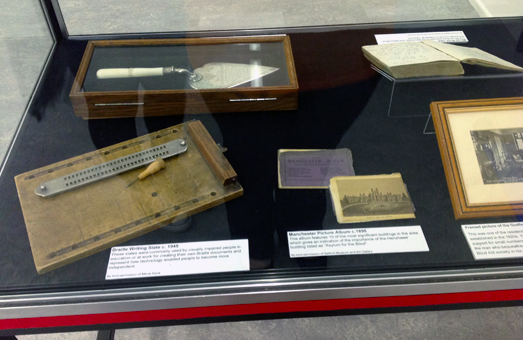
Following on from the chest is a display case of important local items, including; a bell from the Henshaws Blind Asylum School (1920), a minutes book from the Manchester and Salford Blind Aid Society (1904), Henshaws Souvenir Book (1937), and Isabel M. Heywood's O.B.E (1930) for her services to the blind, creating the Manchester and Salford Blind Aid Society. A Manchester Picture Album (1895), Braille Writing Slate (1945), a Framed Picture of the Godfrey Ermen Home for the Blind (1920) and Ceremonial Trowel (1964) are also included in the display case.

Special artefacts relating to Henshaws

RNIB PENfriends are situated between each display case of special objects, housed on a plinth with corresponding stickers preloaded with information, allowing VI and blind visitors (or those choosing to be blindfolded for the exhibition's sensory tour) to read the information that is printed on the labels located next to each object in the display case.

A PENfriend is an electronic device, in the shape of a pen, that enables the sight-impaired to record their voice onto labels and identify different objects. The audio track on the MP3 player will mention when a plinth of PENfriends is nearby so that further information can be obtained from the stickers relating to the items in the corresponding display cases.

RNIB PENfriend housed in plinth

The next items in the exhibition are located on the wall, and feature photographs and a printed emblem. The photographs are of Miss Isabel M. Heywood, O.B.E. and the founding Trustees of the Manchester and Salford Blind Aid Society (with Miss Heywood in the centre). The society was founded in 1900 and opened a small home at The Crescent, Salford and developed by opening more homes and workshops over the years. They later merged with Henshaws in 1980.

The printed emblem is that of the Manchester and Salford Blind Aid Society, with the tagline "to lighten the world for the blind". Inside the emblem is an illustration of a winged angel holding a torch, comforting and helping a young woman who has fallen to her knees. Scrolls surround the top of the illustrations with the words 'friendship, instruction, recreation and help'.

Manchester & Salford Blind Aid Society emblem

The next display case contains various crockery from the Oldham Bluecoat School for the Blind, which was set up using funds bequeathed by Thomas Henshaw in his Will, as well as a selection of miniature hats that Thomas Henshaw used to showcase his designs; Henshaw was originally a Hatter businessman. Thomas Henshaw's wooden cane, and a child's bag made at the Oldham Workshop for the Blind are also displayed.

Above this display case is a bronze plaque from the 'Institution for the Blind' in Oldham, from 1933. The plaque was unveiled by Councillor Marjory Lees to commemorate the opening of extensions to the original building.

Child's bag made at Oldham Workshop for the Blind

The next section of the exhibition focuses on the development of adaptive writing styles for the blind; including Braille, Moon, New York Point, Boston Line Type and Fishburne.

Books containing different tactile writing styles

A display case houses different texts incorporating some of these adaptive writing styles, with more information provided by the PENfriends located on the adjacent plinths. The display case in this section contains tools that were used to create these writing styles, including; a Hughes Typograph, Klein Type Pin Brailler, and Braille Training Computer LED Visual Aids. Also included in this display case is a set of embossed dominoes adapted for blind players, and a Braille Micrometer used in machinery.

Braille training computer LED visual aids and Braille Micrometer

Displayed on the wall above this display case is an oil on canvas portrait of William Hughes, inventor of the Typograph for the blind. While he was the Director of Henshaws Blind Asylum in the mid-1800's, he invented a typewriter for the visually impaired and blind which won a gold medal at the 1851 Great Exhibition at Crystal Palace in London. It is arguably the first ever typewriting machine.

The audio tour brings us to the next section of the exhibition which is focused around the five most common eye conditions causing blindness in the UK, as well as showcasing treatments and tools used by Doctors of the past to treat these conditions.

Common Eye Conditions

The common eye conditions include Cataracts, Diabetic Retinopathy, Age-related Macular Degeneration, Retinitis Pigmentosa and Glaucoma. The PENfriends in this area describe the conditions in more detail and the problems that they cause.

The display cases in this section contain tools used by Doctors of the past to help treat these conditions. Items include model eye balls to study the anatomy of the eye, Optometry testing equipment, hand-painted prosthetic glass eyes, a glass eye bath, an eye scalpel set, Weiss cataract instruments, a Giles Archer colour unit, glasses with extra mounted lenses and horn-rimmed brass framed glasses; all by kind permission of the Thackray Medical Museum in Leeds and the Manchester Royal Eye Hospital.

Hand-painted prosthetic glass eyes

The final portion of the exhibition spotlights how blindness and visual impairment affects people; both those living with their sight condition and the people around them. Opening up this section is my illustration, Elephant in the Room, created specially for the exhibition. It incorporates the theme of how the public react to visual impairment. You can read more about my illustration and the meaning behind it here.

My illustration with Braille and print biography
and description of the piece

Standing proudly with my illustration

I especially loved Anne's audio description of my illustration. She goes into great detail about the colours and mediums I used and the symbols surrounding the piece. She also reads my biography and the meaning behind my artwork.

Next to my illustration is a display cabinet of items relating and belonging to Blind Joe; Oldham's town crier of the late 1800's, named as such because of his visual impairment. Joseph Howarth was so fondly remembered that he was immortalised in a statuette not long after his death.

Display case commemorating Blind Joe

The display case contains aforementioned statuette, as well as Joseph's bell that he used when employed as a town crier giving the news to those who could not afford a newspaper or could not read, as well as his favourite cup.

Model of the Henshaws Blind Asylum, 1857

A stone model, contained in a glass case, represents the Henshaws Blind Asylum previously located on Chester Road, in Old Trafford. It housed the blind as well as providing a school for the 'deaf and dumb'. It was demolished in 1971 when the college was relocated to Harrogate.

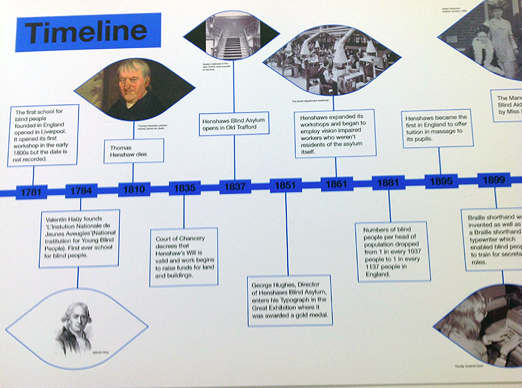
The model is followed by a timeline of the history of Henshaws and major events and achievements within the visually impaired world, such as; the invention of Braille shorthand in 1899, Henshaws Blind Asylum changing its name to Henshaws Institute for the Blind in 1921 and finally Henshaws Society for Blind People in 2000, showing the changing attitudes of the public, Germans training German Shepherds, Dobermans and Airedale Terriers to lead their war-blinded soldiers in 1921, the British Wireless for the Blind Fund being set up to provide a free radio to every blind person in the country in 1929, and Henshaws celebrating its 175th birthday in 2012.


Henshaws and visual impairment timeline

To the right-hand side of the timeline is a model representation of a Napoleonic Soldier. Many lost their sight during this War, and subsequent ones too, fighting for their country. They would return home to poverty with no help from the Welfare State and would be left begging for themselves and their families. They would continue to wear their uniforms out of respect for their country and as a badge of honour.


Concluding the exhibition is a separate audio section with interviews from four service users of Henshaws. They describe how their lives were previous to their visual impairment and how Henshaws has greatly benefitted their confidence, independence and skills through the various service, support and social groups that they provide.

I had a wonderful time visiting the One Man's Vision exhibition using the audio tour and tactile lines to make my way independently around all of the exhibits. I learned many new things that I didn't know before including some of the adaptive types of tactile writing for visually impaired and blind people, the story of Thomas Henshaw and his Will, and the history of blind societies in my local area.

It was extremely fascinating and I would urge anyone to visit this interesting and completely accessible exhibition.

Image Gallery

Here is a gallery of all the photos I took whilst visiting the One Man's Vision exhibition. Click on the thumbnails to enlarge.


Workshops

There are a number of workshops and talks planned in the near future relating to the One Man's Vision exhibition. Feel free to come along and enjoy artist-led sensory workshops, inviting you to be creative without vision!

Saturday, 18th October: Drawing Workshop
Saturday, 25th October: Mystery objects
Tuesday, 28th October - Friday, 31st October: Create tactile and sensory artworks with artist Hannah Cawthorne
Saturday, 1st November: Create tactile and sensory artworks with artist Hannah Cawthorne
Saturday, 22nd November: Special tour by the exhibition's curator Laura Wigg-Bailey

The One Man's Vision exhibition is open until January 18th, 2015. Visit the official website for further information, events and blog posts.

You can view all of my previous posts regarding my involvement with the installation of the exhibition, as well as creating a special illustration to be displayed alongside the items and objects of interest, by clicking here.