Welcome!

INTRO POSTFAQ'sMY STORYPOST DIRECTORYTWITTERPINTERESTTUMBLR
Showing posts with label Independence Skills. Show all posts

Tuesday, 4 August 2015

RNIB Roundup:
Product Videos and More!


I have a variety of exciting things to share with my readers that I have been involved in with the RNIB since my photoshoot earlier this year; from product videos, to an appearance in the Vision magazine, thank you gifts and even being featured on the official RNIB Facebook banner!

Take a look below at some of the projects I've been involved in throughout the year!

Product Videos

Earlier this Spring, I filmed new product videos with the RNIB for their online store; demonstrating how I use the liquid level indicator and Perkins Brailler with corresponding labelling tape adapter. I have now received the final edited videos and have provided a useful transcript underneath each clip.


In this product video I demonstrate how I use my liquid level indicator on a regular basis to avoid spilling my drinks and to accurately define when hot liquid is reaching towards the top of a cup:

"The liquid level indicator is a device that hooks onto the side of a cup or mug. It has 3 prongs, that are metal, that helps to detect when the water is nearing the top of the cup. 

I'm Kimberley Burrows, I'm 26 and I was a premature baby and my Optic Nerves didn't develop properly. If I didn't have my liquid level indicator then I would certainly be having a lot more accidents! It just gives me a bigger sense of confidence around my kitchen. One thing that's great about the liquid level indicator is that it's magnetic; so I keep mine on the side of my fridge so that I know where it is and don't end up losing it!

I use my liquid level indicator for pouring every drink, whether it's hot or cold. When the water is nearing the three prongs it will vibrate and beep - so it's dual-sensory in that it's audio and touch as well. There are two levels; when it's coming to the first level it will be quite moderate in its vibrating and beeping, and nearing the top it's time to stop then.

The liquid level indicator is an example of something simple that can make a huge difference. Visit RNIB's shop for more ideas at rnib.org.uk/shop"


In the second product video I demonstrate how I use my Perkins Classic Brailler and Labelling Tape Adaptor for everyday organisation, labelling of food items and creative writing:

"I first used a Perkins Classic Brailler a few years ago. It's quite easy, just like writing, and it just flows out really!

I'm Kimberley Burrows, I'm 26 and I was a premature baby and my Optic Nerves never developed properly. I first discovered the Perkins Classic Brailler when I starting doing a Braille course. When I first used the Brailler it was just amazing and it opened up a whole new world of communication for me. I personally use it to write stories and jot down notes and I also Braille my labels.

There is a label adapter that I add to the back of the Brailler which feeds through the same way as a piece of paper would. This allows you to then feed tape through and Braille onto the tape to cut off to add to cans, DVDs or CDs. If I didn't use my Brailler to label soups that it could end quite disastrously! I could be getting something completely different out of the cupboard - it could be dog food! So it saves me from humiliation, really. It helps to me spotlight a certain item and I just need that independence.

The Perkins classic is one type of Brailler that's available from RNIB's online shop. Visit rnib.org.uk/shop"

RNIB Shop

Over at the RNIB online shop I can be seen heading the Braille products, with additional photos under the Perkins Classic Brailler! You can view the full range of products available by the RNIB, from magnifiers to lighting to talking products, by visiting their online shop.

Vision Magazine

I can be spotted in the latest issue of Vision, RNIB's magazine for subscribing members, promoting the Perkins Classic Brailler. Article reads:

"Products to make everyday life easier: You can now review products and watch demonstrations on our new online shop! We have listened to your feedback and introduced a number of new features to our new online shop. As well as adding your own product reviews, you can also watch and listen to short films featuring people who use the products.

Kimberley is a keen Braille reader: Another film features Kimberley - a keen Braille reader and writer. Her Perkins Brailler helps her compile short stories as well as to produce braille labels for everyday items - including food items!

Kimberley uses the labelling tape adaptor for Perkins Brailler (code BM42). The white plastic labelling adaptor sits neatly on the back of the Perkins carriage. You then simply slide your Braille labelling tape into the clips at either end of the adaptor, which keeps the tape in place. There's also an adaptor for the Next Generation Perkins Brailler (BM43) and you can use both the 9mm tape and 12mm tape in the adaptors, available in clear or black."
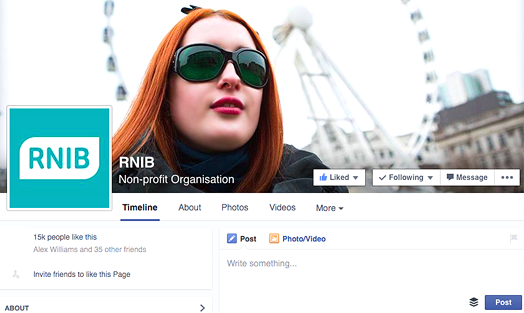
Facebook Page

I'm very honoured to currently be featured in the RNIB's Facebook page banner! It's a huge privilege to be the first thing that many visitors see when they visit the social networking site and means very much to me, indeed!

I also received a wonderful tweet of support
from RNIB's Twitter page too!

Thank You Gifts

...And finally! I have received some wonderful gifts from the RNIB as a thank you for taking part in their projects this year; including a card with a handwritten thank you note from the team I worked with as well as two prints of my photographs taken at MediaCity UK in Salford Quays!

I really enjoyed filming my product videos and taking part in photo sessions for RNIB and would like to thank them for inviting me to be involved with their projects!

Wednesday, 3 June 2015

The #blindgirlbeauty Tag!

Welcome to the #blindgirlbeauty tag!

I was nominated by Emily Davison of fashioneyestawho teamed up with VI blogger and YouTuber Molly Burke, to share tips and tricks for applying make-up, piecing outfits together, selecting accessories and generally defying the stereotypes of what people think a blind person should look like. You are more than welcome to take part too! Simply use the hashtag #blindgirlbeauty, share on your social media accounts and nominate your friends!

What is the hardest product to apply as a
person who is blind or visually impaired?
For me, the hardest product to apply is lipstick; especially when it's well used and no longer holds its original pointed shape. Throughout the process of application I worry about getting it all over and completely missing the outline of my lips, so end up taking such a long time with it. To aid me, I'll either use my hand as a barrier against the edges of my lips or apply in small amounts to the middle of my lips and then use my fingers to blend it out. A sighted pair of eyes is always needed to ensure it looks clean, well-defined and as natural as possible! I much prefer to use a lipgloss from a squeezy tube so that I have control over the amount I'm using and its distribution as I'm spreading it.

What is your number one tip for shopping with vision loss?
Take your time, enjoy yourself and don't feel pressured into buying anything that doesn't feel right to you. Shop with a best friend or close family member for the best results or ask a shop assistant if you need an opinion on what looks best from a sighted perspective - though do follow your own initiative as well. Something may look good on you in someone else's eyes, but if you feel it's not really representative of "you" and you don't feel comfortable then take that into consideration as well. I enjoy shopping online, reading the various descriptions of cosmetics, clothing and accessories with the VoiceOver functionality built-in to my MacBook, so don't always feel you that have to endure the hustle and bustle of going into a busy store in order to purchase what you want. It can be done at home instead and the excitement comes with the waiting!

What is the one beauty item you stay away from due to vision loss?
Tanning products! They are so easy to get wrong, either by applying too much or accidentally creating a streaky / patchy look, so I tend to stay away completely. As someone with naturally auburn hair (though enhanced professionally to create a more noticeable look), therefore having a very fair and freckled complexion, I embrace my paleness instead and avoid being pressured into feeling like I have to be spray-tanned in order to feel beautiful showing my skin in the summer months. I'm pale and proud!

As I also mentioned I have my hair coloured professionally. I avoid boxed dyes as I wouldn't have the first clue as to whether I've applied the dye evenly to my roots and throughout the rest of my hair, and I don't trust that it will be healthy enough for my dry and thick locks. Not to mention the mess I would most certainly make in the bathroom! I feel much more comfortable consulting a professional who has seen my natural reddsih-brown shade, knows how I want it to look (Florence Welch and Merida from Brave were the main inspirations behind taking my shade to the next level in early 2012!) and do so in the correct way that is safe and nourishing to my hair.

What tips would you give to a young girl struggling
with vision loss who wants to get into makeup?
Experiment and have fun. You will learn from your mistakes and get better with practice. Get used to the shape of your face and where your features are, and stick to shades that best match your complexion and skin tone. Invest in good-quality cosmetics, brushes and accessories for the best results when you feel you have mastered the basics. If you are severely visually impaired like myself, or blind, and don't have enough useful vision - use a handheld Braille labeller or RNIB PenFriend to label your products, listing their shades, so that you can identify your cosmetics and create different looks independently without needing the assistance of a sighted person.

How did you learn to apply make-up as
someone who is blind or visually impaired?
I first discovered make-up when I was 14 years old and I still remember the first products I ever bought. I used cheaper brands to start with while I was still learning the application process and getting familiar with the shape of my face, eventually investing in higher-quality cosmetics, that don't test on animals, as I got better and started to enjoy putting my make-up on without sight. Practice makes perfect, so rest assured I made a lot of mistakes to begin with!

What is the one thing you think every girl
should be able to do without looking?
Mascara and blush are by far the easiest products to apply - so everyone should be able to do these two without looking in the mirror. Applying mascara may sound daunting to someone with a visual impairment but once you get the hang of it it can be a very quick process. Simply tilt your head back so that the wand, or mascara's brush, catches your lashes - rather than poking out your eye! - and wiggle whilst applying to evenly distribute the product through. To finish, I tend to run my finger over my lashes just to catch any excess product and prevent it from clumping. Blush, or a bronzer if you prefer, is also an easy task. Find the bottom of your ear lobe and use this as a guide of where to apply on the apples of your cheeks. Sweep lightly from the direction of your ears to start with and gradually build it up for a more natural look.

Do you think not being able to see
yourself affects your self-confidence?
Absolutely not. Just because I can't see my own reflection doesn't mean I can't feel beautiful. Beauty is not a visual thing; it's how you perceive yourself to be from your character and your actions. Knowing the time and effort I have put into my appearance - through choosing my outfit, applying my make-up, and selecting matching accessories - elevates my self-confidence and sense of worth, giving me a foundation on which to start my day. Of course, this won't necessarily be the same for someone else with a visual impairment. Feeling beautiful in an individualistic thing. It's about how I feel and not how I look!

Name one thing you need help with
when it comes to beauty or fashion
Applying nail varnish. My mum still does this for me while I'm in the process of figuring out how best to do it on my own. I have tried a few methods such as adding tape around my nail as a guide, but found that it still wasn't as accurate as I would have liked it to be and was rather fiddly to do! I've also tried applying a small blob of varnish to the centre of my nail and then slowly, using circular motions, spreading it outwards - but again this hasn't been as successful as I would have liked and I still manage to paint over my nail onto the surrounding skin of my fingers. Using a corrector pen isn't always helpful as I will take varnish off from my nail if I don't aim it correctly. I will get there eventually but this is something I clearly need to practice!

What is a blind girl beauty or fashion essential?
I think one beauty essential that every girl needs is a good lipgloss or lipstick, depending on your preference. It's the basis of a look and nourishes your lips at the same time whilst giving a pop of colour. A fashion essential is a good pair of comfortable, yet stylish, shoes and a handbag that matches and sets off your overall look. Always try to colour co-ordinate as much as possible!

What is the best part about applying
make-up as a person with vision loss?
Feeling a sense of accomplishment at doing something so visual, independently, without relying on the aid of a mirror. Knowing that your looks from any two days will never be the same, and being unique with your perspective and approach to beauty and applying products.

Have you ever experienced any major fashion or make-up
disasters in the past that are due to having vision loss?
Of course! I previously mentioned that I remember the first ever products I bought when I first got into cosmetics; these included a lilac glitter eyeshadow, bronze blush and a baby pink lipstick - and I am squirming as I type! The colours sounded cute to me when described but as someone with a severe visual impairment I didn't quite have the sufficient vision to see just how garish they were. My choices were a disaster in themselves though it was the early 2000's, at the height of the frosted make-up trend and butterfly clips, so I think I can be forgiven for my choice in mis-matched and daring pastels!

Also in the early days of my make-up use, I could never quite find an ivory foundation that matched my pale skin tone so would have to settle for whatever was available in Boots or Superdrug at the time. This was, more often than not, a slightly darker and more yellow-based foundation than what I wanted!

Do you ever have people commenting that
you don't look blind / visually impaired?
I did before I chose to wear UV glasses in 2008 and before I qualified with my Guide Dog in 2014; people just thought I was clumsy when I bumped into things or had sensitive eyes because they flutter and move often with my condition. I don't get it too much anymore, but still do receive a lot of comments such as "You are so pretty for a blind person" - whatever that is supposed to mean!

Do you use any pieces of assistive technology or apps to help you
when putting outfits together or doing your make-up?
The RNIB PenFriend, Dymo Braille labeller and a Colour ID app on my iPhone are all essentials and lifesavers! I use the handheld Dymo Braille labeller to label up my cosmetics, creams, and shampoo and conditioner and the RNIB PenFriend with small labels (that I vocally record onto) to identify my make-up products, with machine-washable labels for my clothes. The Colour ID app on my iPhone helps me to distinguish what colour an item of clothing is, along with any colours within intricate patterns in the fabric, when I'm unsure because of varying light conditions that affect my remaining sight. Anything else, such as choosing accessories or shoes, is identified by touch as I love tactile pieces incorporating sequins, jewels and pearls.

Don't forget to check out Emily's #blindgirlbeauty tag blog post and video as well as Molly's video to find out their answers to the above questions. Both ladies are fantastic for all things inclusivity and fashion!

Tuesday, 30 September 2014

Skillstep: First Aid Certificate


During the 12 week Skillstep course, provided by Henshaws Society for Blind People, one of the sessions was focused around First Aid training; learning the recovery position, the process of resuscitation, how to correctly treat burns, cuts and wounds, as well as discovering how to support someone with conditions such as diabetes, epilepsy, asthma and heart issues.

I recently received my certificate in the mail to show that I have qualified my one day training session, and it will valid for the next three years!

You can view all of my previous Skillstep posts, submitted on a week-by-week basis, by clicking here and you can find out more about the course itself by clicking here at the Henshaws website, where you can register your interest to the course via e-mail.

Thursday, 4 September 2014

Skillstep Group Photos

At the end of the Skillstep course, the group and I were invited to have some professional photos taken to be used on the Henshaws website and in other promotional material to showcase what the course provides and what can be attained from it; including confidence, independence, social skills, peer support and employability skills.

I received our photos today and wanted to share them with you here on my blog!


A big thank you to Gwen Riley Jones for the lovely group shots!

You can view all of my previous Skillstep posts, submitted on a week-by-week basis, by clicking here and you can find out more about the course itself by clicking here at the Henshaws website, where you can register your interest to the course via e-mail.

Saturday, 16 August 2014

Skillstep: Week 12

The Skillstep course has now sadly come to an end. All 12 weeks have been completed and my portfolio is finalised and ready for accreditation.

Over the past 3 months, the group and I have massively developed our vocational skills, employability skills, social skills and IT skills; as well as expanding our social circles and making new friends. We all feel self-assured and confident in ourselves as visually impaired and blind people of varying ages and abilities and can achieve anything we put our minds to!

Our final week began on Tuesday with a visit from Elaine, based at Trafford College, who talked to us about our work placements and what skills we feel we developed from undertaking our new temporary roles along with which existing skill we put to good use. I personally felt like I was able to expand my already established social and communication skills by being in a different working environment, and also developed my care skills tremendously - which will benefit me when I become a Guide Dog owner in the very near future. We also discussed our next steps after the course comes to an end and what our aspirations are for the future.

The group and I walked from the Henshaws Manchester Resource Centre further down Talbot Road to Trafford College, and were provided with a tour of the complex by Elaine; who also gave a brief overview of some of the courses that are on offer and the different qualifications that can be achieved and accomplished through the college, if we decide to continue with further education. Prospectuses were provided to those who wanted them.

In the afternoon, Elaine opened discussions within the group of how the vocational portion, provided by Trafford College and tutored by Maureen during her Tuesday sessions, could have been improved - especially through the accessibility of the learning log and accreditation sheets, as well as the way the course was delivered to us. Suggestions and improvements were provided and will be taken on board for the new Skillstep groups in the future. 

During Wednesday morning we were visited by Helen Doyle, Research and Information Manager at Henshaws, to discuss how we found the course and what we especially enjoyed about it - as well as which areas had room for improvement. All of our feedback was positive and was recorded digitally to then be typed up into notes to implement within future courses. I personally liked the length of the course - neither too long nor too short - and I especially enjoyed the variety of topics that the Wednesday sessions provided; introducing us to some new aids and equipment and the Access to Work scheme, refreshing over Braille, the iPad, First Aid and mobility aids and techniques, a cooking session to channel our creativity and work together as a group, travelling down to the Guide Dogs Training Centre, and having visits from the Police, National Careers Service and Transport for Greater Manchester.

Wednesday afternoon Muhammed Karim, Diversities Co-ordinator from Transport for Greater Manchester, came in to talk to the group and I about concessionary passes for blind and visually impaired people and what projects they are in the process of working on in the near future to make transport more accessible to those suffering from sight loss. We were welcome to ask questions and provide suggestions and feedback for Muhammed to then take note of and feed back to the team.

On our final day, on the Thursday, we all went out to Wetherspoon's, relatively close to Henshaws, for our meal along with Skillstep co-ordinator, Julie Parrish. The Big Lottery Fund and Henshaws kindly provided our meal and first drink, and additional drinks and courses could then be purchased by ourselves afterwards. I was one of the final members of the group to leave in the evening and found it very bittersweet but lovely to be able to finish the course in such a nice way.

I'm really glad that I took part in the Skillstep course; I have taken a lot away from it and feel a lot more confident in regards to employability and future interviews especially. My favourite part of the course was definitely my work placement with Guide Dogs and I'm extremely grateful to Julie and to the Guide Dogs Training Centre for making that possible! I had such a fantastic time and learned some really valuable skills. I also really enjoyed the social aspect of Skillstep, I have some fantastic friends that I will be keeping in touch with for such a long time to come.

You can view all of my previous Skillstep posts, submitted on a week-by-week basis, by clicking here and you can find out more about the course itself by clicking here at the Henshaws website, where you can register your interest to the course via e-mail.

I want to say a big thank you to Julie Parrish, Henshaws Society for Blind People and The Big Lottery Fund for providing such an invaluable and beneficial course!

Thursday, 24 July 2014

Skillstep: Week 9

I have now finished the initial 9 weeks of the Skillstep course! This marks the end of the vocational and IT work which is now all completed, in chronological order, signed off and ready to be marked for accreditation in my portfolio.

Week 9 has been a very intense few days; with 2 presentations and a mock interview to tackle!

The week began with the final session with Maureen from Trafford College. After ensuring all of our work sheets were completed, learning logs were filled in and the objectives of the course were met - it was time to present our individual presentations based on our future goals, research and preparation undertaken to achieve the goals and the barriers that we may face. After each presentation was given to the group, constructive feedback was given by Maureen and the rest of the Skillstep group as to how it could be improved.

My future goal was based on my fundraising project that I am currently in the process of completing for the Henshaws Bright for Sight campaign in October. I explained my project in detail, the preparation and research I had undertaken in the form of a questionnaire which I used earlier this year with friends, family and fellow Henshaws service users, the marketing tools I will use and the predominant barriers that I have faced and may still face in the coming months. As I have given a few speeches in the past, my technique is rather perfected and I was calm and confident in my approach to the presentation itself.

I used quite a few props and was the only member of the group to do so, which I feel helped when presenting my goal as I then had a visual item to refer to - most of which were tactile, and included a Braille leaflet I had made. My presentation was 2 minutes longer than it should have been, as we had a 10 minute limit, and I was cut off half-way through as Maureen thought my 10 minutes were up - but aside from that, it went quite well.

On Wednesday, it was time for mock interviews with Andrew Rose - a member of the Board of Trustees for Henshaws, who has vast knowledge and experience of conducting interviews and recruiting employees. Unlike the day before, I was rather nervous in regards to the interview - as I have never done an interview before and, even though I had prepared for a range of questions, didn't know how it was going to turn out. My interview was for the role of a children's illustrator, one I hope to be able to do in the future, and I brought my portfolio and CV along incase they were needed, and I received extra points for doing so! My interview went fantastically well, so much so that Andrew told me that it was the best of the day (my slot was near the end) and he had no feedback to give in order for me to improve. I was so thrilled that it turned out well and I want to say a big thank you to Andrew for donating his time to us Skillsteppers!

On the final day of the week, during Linda and Neil's session, it was time to present the PowerPoint presentations that we worked on during the previous week. In the morning, we had some extra time to finish our work and we then practiced our presentations before lunch. After dinner, we presented the PowerPoint presentations properly to members of the Fundraising & Marketing team and it was recorded by Neil to be produced into a CD for future groups to refer to and for the Big Lottery Fund to view. It was great to hear everyone else's experiences during the course and it made me really nostalgic for the start of Skillstep - but also happy to realise how the course has changed me and how I now have a new network of friends that I will definitely keep in touch with!

During the next fortnight, the group and I will be doing our individual work placements. Mine will be at Guide Dogs, which is something I was enthusiastic about and chose right at the start of the course. I have been signed up for a Guide Dog for nearly 11 months and am due to start my harness training very soon, so my placement will be extremely beneficial to me. I have found out that I will be doing things such as puppy training and grooming - so am very excited indeed to get started!

You can find out more about Skillstep by clicking here and can register your interest to the course via e-mail.

Thursday, 17 July 2014

Skillstep: Week 8

I have now finished week 7 of the Skillstep course! The group and I only have one more week left of vocational work before undertaking our work placements for the following fortnight!

In Tuesday's session, Maureen prompted the group and I to think of skills and qualities that make a successful employee and again for a good team player; and found that a lot of these qualities overlapped from to the other. We spent the rest of the session planning our presentation for next Tuesday where we will each be spending around 10 to 15 minutes presenting and talking about our future goals, the barriers involved, and how they meet the SMART target criteria. I have my presentation pretty much prepared for the next session - I just need to organise my props! My presentation will be focused on my short-term goal of crocheting at least 15 bunnies to sell for the Bright for Sight campaign, during October, to be displayed at the front desk of the Henshaws Manchester resource centre. I will provide more details of my goal and how the presentation went in next week's Skillstep post.

In Wednesday's session, we were visited from Nick who gave us a First Aid session for the day. We learned the ABCDE's of emergencies, how to call for help, how to give CPR, and how to put someone into the recovery position - as well as learning about conditions such as Diabetes, Heart Attacks, Asthma and Shock. It was a very informative session, and one of my favourites of the course, as it was very hands-on - we even got to practice on CPR Annie dummies! We each passed the First Aid assessments and will soon receive a certificate which will be valid for the next 3 years.

In Thursday's session, with Linda and Neil, we were introduced to Microsoft PowerPoint and were talked through the basic steps of how to set up a presentation with slides, animations and transitions and how to insert images. We were teamed up into pairs to create a PowerPoint presentation of the Skillstep course, with each slide representing a different factor of the course of our choosing. In next week's session, we will showcase our PowePoint presentations to the group, alongside giving a talk about the course using the bullet points from each slide as a prompt.

As I mentioned previously, next week is the final week of vocational work for the course - and will be quite an intense week - with 2 presentations and a mock interview!

You can find out more about Skillstep by clicking here and can register your interest to the course via e-mail.

Friday, 11 July 2014

Skillstep: Week 7

Week 7 of the Skillstep course is now complete!

I was only able to attend 2 of the 3 days this week, as I attended a conference in Liverpool at St. Vincent's School for the Blind yesterday; of which there will be a blog post very soon!

During Tuesday's session with Maureen we looked at assertiveness, decision-making and reducing stress. We started with assertiveness first and differentiated between assertiveness and aggressiveness and how they are not the same, the benefits of assertiveness in that it provides you with credibility, respect and the outcome you want and then demonstrated these new skills in a roleplay scenario which was recorded for our video portfolio for evidence in our accrediation. We looked at decision-making next, and how we prioritise tasks in order of importance to make our decisions; through exercises that involved choosing from a menu and setting up a new home. The session was concluded by looking at ways of reducing stress - through techniques such as relaxation, counted breathing and a stress journal.

Puppy Trainer with Yoda

On Wednesday's session, the Skillstep group and I visited the Guide Dogs training centre in Atherton for a guided tour around the kennels, a talk from a puppy walker and his boarded puppy Yoda - who will soon be undertaking her Guide Dog training! - as well as talks from members of staff including a mobility officer, and visiting the agility arena to partake in a blindfolded walk for harness training and a demonstration performed by current Guide Dogs in training and their trainers. We had a photo session too!

Kennels at the Guide Dogs Training Centre


Obstacle course inside the training arena

Thursday's session was focused around concluding the 29 tasks for Entry Level and Level 1 accreditation, and signing off work in both our own portfolios and Linda and Neil's portfolios to then be looked at by an examiner. During next week's session, we will be looking at Microsoft PowerPoint and using it to create a presentation to then communicate to the rest of the group in pairs.

You can find out more about Skillstep by clicking here and can register your interest to the course via e-mail.

Friday, 4 July 2014

Skillstep: Week 6

The Skillstep group and I are now at the half-way point of the course, as Week 6 draws to a close!

During Tuesday's session with Maureen, we looked at social situations that make us uncomfortable and identified the key elements of what made us uncomfortable during that particular situation. We then identified the characteristics and behaviours of the best boss / best teacher and worst boss / worst teacher we have had in our education or work careers so far - and each member of the group found that it was not their IQ, capabilities or qualifications that made them the best or the worst teacher or boss, but in fact, their social skills - or lack thereof! - played a vital role instead.

This led into the introduction of Emotional Intelligence. It is a concept that was invented a while ago by various psychologists, who realised that while some individuals will be high flyers with a high IQ and many qualifications - they won't be equipped with an EQ (Emotional Quotient) to deal with social situations and communicating with people. The psychologists identified certain characteristics and behaviours that are fundamental to successful relationships with people in the workplace and help you to have a better sense of well-being. You can improve your EQ and it can be taught and learned.

Towards of the end of the session, we looked at negotiation skills to mediate a conflict and achieve the outcome we want as part of a performance piece that was recorded for our portfolios for accreditation. The performance is part of a confidence-building process, so that we can identify what to do in a tricky situation.

On Wednesday morning, Glynis visited the group to give demonstrations of equipment that could be of benefit to us as visually impaired and severely visually impaired people. Quite a few of the aids were items that the majority of the group already owned or had heard of and some were completely new items that we had never been introduced to before. Aids and equipment that were demonstrated included: a liquid level indicator, a needle threader, a Braille ruler, a PenFriend, a Colour Identifier, Braille labeller, envelope writing guide, talking scales, talking clock, and a plastic iron guard that surrounds the bottom of an iron to prevent you from burning yourself - something I had never heard of before and really liked the idea of. This was a fantastic session and I really enjoyed being re-introduced to some items that I hadn't been in contact with in a long time, due to the advances in mobile phone technology providing apps instead, replacing the Colour Identifier aid - for instance.

On Thursday, during Linda and Neil's session, I completed all 3 of the sample assignments that were provided to me in Braille and then had my own bits and pieces to do on my iPad that kept me occupied for most of the day; sending e-mails, updating my social media profiles and writing my next contributor blog posts for Living Paintings and Henshaws - as well as preparing some future blog posts for my own personal blog.

You can find out more about Skillstep by clicking here and can register your interest to the course via e-mail.

Sunday, 29 June 2014

Skillstep: Week 5

I have finished another week of Skillstep, and I'm now nearly at the half-way mark of the course! As always, I wanted to blog about what progress the group and I have made in our vocational and computer sessions this week for you to read. Information regarding Skillstep can be found at the bottom of the post.

During Maureen's session on Tuesday, we delved further into our short-term personal goals that we briefly looked at during the end of last week's session. We identified our goals using the SMART targets - Specific, Measurable, Achievable, Realistic / Relevant and Time-Bound - and also looked at our past achievements to help build our self-confidence for accomplishing future goals. We developed an action plan with four easy steps to pin-point the activities we need to undertake in order to attain a personal goal. Towards the end of Tuesday's session, we discussed as a group some metaphors to describe the obstacles in our paths and how we can overcome them. In forthcoming sessions, we will be looking at mind-mapping for personal growth and development.

On Wednesday, the group and I were visited by Fiona James - a Crime Reduction Specialist based at the Salford Crime Prevention team, within Greater Manchester Police. She has worked in the police force for 28 years, and it is her job to reduce crime happening in the first place; though it cannot be prevented completely, the amount of crime itself can be reduced in the local area. Fiona can be heard every Friday, at 11am on Salford City Radio, giving crime prevention advice and tips on The Safety Factor.

After giving a brief overview of her job and the work she does, Fiona talked about the after-care that she and her team provide to recent victims of crime in Salford and also provided statistics to show that domestic burglaries are actually going down in recent years - around 4 or 5 each weekend, and some weekends there will be no cases at all. This could be due to a number of reasons - the first being that a lot of members of the community now have better home security - helped by the GMP's recent work with Salix Homes and City West. Another factor could be that criminals are now more focused on fraud in the online landscape.

We were given some general safety advice and tips - such as always double-checking at night that windows and doors have been closed properly, especially during the summer months concerning the downstairs windows, when moving to a different part of the house. Safety advice was also given regarding cash points, using the internet and mobile phone safety.

In the afternoon Julie Parrish, our Skillstep Co-ordinator, discussed the Access to Work scheme with us; what it is and how it works. It is a government-run programme, delivered by Jobcentre Plus and introduced in 1994, helping those with disabilities, health or mental health conditions to overcome barriers when moving into or retaining employment. It is a flexible programme that focuses on the needs of the individual and their circumstances. It is required when the employee requires support or adaptations, which an employer is legally obliged to provide under the Equality Act of 2010.

Julie explained the eligible criteria for help, reasonable adjustments, cost sharing, how to apply and the types of support available - such as special aids and equipment, travel to and in work, a support worker, communication support, mental health support service and so on.

On Thursday, during Linda and Neil's IT session, I completed some extra assignments - having completed the Level Entry and Level Entry 1 tasks over the past month - which are used as examination pieces, weaving together all of the skills I have learned on the course so far using assistive technology in Microsoft Word. I found it easiest to work from Braille worksheets and to then follow the instructions to complete the scenarios. Even though no extra accreditation is given for completing the extra assignments, I was rather enjoying them by the end of the session and found it quite therapeutic! I had tried the audio cassette earlier in the session but had a few issues with only having the audio in one ear, as I have hearing problems, so switched to the Braille format instead. I'll be continuing the assignments next week and will then move onto Braille spreadsheets - if possible!


At the weekend, the Skillstep group and I met up in the Manchester city centre for a meal and some drinks afterwards. I had a really lovely time being with the group in a social setting and would love to meet up again sometime soon!

You can find out more about Skillstep by clicking here and can register your interest to the course via e-mail.

Thursday, 19 June 2014

Skillstep: Week 4

Another week of the Skillstep course, at the Henshaws
Resource Centre in Manchester, has now been fulfilled!

The week began with roleplaying activities on Tuesday during Maureen's session. Each member undertaking the course had the opportunity to act within 3 different roles and become an interviewer, interviewee and observer giving feedback for improvement for others in their group, as well as discussing what worked during their practice interviews. We had to prepare prior to the session, thinking about our answers to typical interview questions as well as providing 2 of our own to use while performing the interviewer tole. We were recorded on a video camera for evidence regarding our portfolio for accreditation. In the afternoon, we briefly touched upon goal-setting and the SMART targets, which is something we will continue to develop further in our fifth session next Tuesday.

On Wednesday, Alan Bennett from the National Careers Service visited us to discuss careers advice and how to maximise our chances of securing a job in today's career climate. He began his session by first of all explaining job centres, their function and what they can provide for disabled people - as well as going into detail of different job-searching websites such as Universal JobmatchIndeed and Fish4Jobs. Alan then talked about the importance of an up-to-date CV and the different types that can be used - Functional, Chronological and Combined - and the benefits of each one. This led into a Powerpoint presentation of some badly written CVs and how they could have been improved - for us to then take these suggestions and tips away with us and apply to our own CVs, to ensure they are as concise, accurate, relevant, targeted and easy to read as possible - to sell our skills and experience.

Alan shared some handy tips - such as marrying our skills to the job description, perhaps even having different versions of the CV for each job that you are applying to, having a punchy first paragraph to grab the employer's attention, to ensure that the first two paragraphs are as striking as possible (as these are the most read parts of the CV itself), making sure to print the document out onto white paper with a clean, sharp font (no Job Centre yellow paper!) and not exceeding 2 or 3 pages; the longer the CV is, the less chance it has of being read in its entirety. It's paramount to use the same font throughout, be consistent with the layout, use specific wording, proof read and spell check for mistakes, divert from use of photos or graphics (these can be provided in a separate portfolio if you are a photographer, graphic designer, illustrator, etc.) and review and update the CV regularly.

This led into the 'Don'ts' of CV writing: don't include your salary in each job section, don't be dishonest (employers very well may check what you present as factual), don't give the impression of flitting between jobs regularly and not being committed in the long-term, don't include irrelevant information (for example, your nursery and primary school - as seen in one of the badly written CV examples!) and don't overuse the same phrases, such as "I am". Alan talked us through Cover Letters and Spec Letters, what they are used for and how they could be useful to us to attach to the front of our CV when applying for a job.

Towards the end of Alan's session, we explored transferable skills and interview skills. We began by examining interview skills first, which echoed most of Maureen's session from the previous week. Good preparation is key - whether it's planning the journey to the interview, preparing your outfit, researching the company or developing your answers beforehand. You may be faced with competency-based questions, in which there is only so much preparation you can do, but try to research as many varieties of questions as possible to display confidence and competence during the interview process. Transferrable skills are those that can be used no matter the job title - such as communication skills, organisation skills and time-keeping. Another job may require a more specific skill set, but these general transferrable skills can be applied to any job and it is important that we develop them if we do not have them already.

We each had a 30 minute individual session with Alan where we went through our own CVs and career options. He typed up the information to be transferred into an action plan that will be presented to each of us in the near future. My CV is up-to-date and absolutely fine with no need for improvement, and I discussed with Alan my desire to go back into further education in the near future, after I have trained for my Guide Dog, to build up my portfolio and qualifications.

On the final day of the week, the IT session with Linda and Neil, I finally completed all of my Level 1 Entry tasks for my portfolio! There were 29 tasks altogether, which included Entry Level and Entry Level 1 tasks as proof of basic knowledge of using a Windows Computer and Microsoft Word whilst using assistive technology such as JAWS or ZoomText. In next week's session, I will sign the remaining pieces of work that I've completed during the past 2 weeks, that haven't been signed by myself yet, as proof that I acknowledge and agree with the marking process by Linda, and have those completed for both my own portfolio and for Linda and Neil's copy of the portfolio too.

You can find out more about Skillstep by clicking here and can register your interest to the course via e-mail.

Thursday, 12 June 2014

Skillstep: Week 3

I have just finished my third week of Skillstep and, as with my previous Skillstep posts, thought I would share with you what the group and I have been up to this week.

It's been an enjoyable few sessions in week 3, especially because of the fantastic kitchen skills session we had during Wednesday morning where the group and I made pizzas and cheesecakes! The mobility session in the afternoon was rather interesting too, providing the opportunity to discover the different canes that I had never been introduced to before, having a feel of them and comparing them to my own long cane. Wednesdays have quickly become my favourite day in the Skillstep week!

During Tuesday's session with Maureen, we touched upon the different learning styles (visual, auditory and kinaesthetic) and identified our own preferred method of learning through a table exercise. I learn kinaesthetically. As a visually impaired person who also suffers from hearing loss, visual and auditory learning can be lost on me sometimes and quite difficult to follow. I much prefer to be involved in a task where I can use my hands and feel like I am applying the skills I am learning, and go through the process in my mind, which can then be easily used again in the future as I have tried it out beforehand.

We also observed a mock interview between Maureen and Julie, the Skillstep Co-ordinator, and made notes of the body language, voice / voice tone and language used between both the interviewer and interviewee, what worked and what could have been improved. Next week, we will be doing our own interviews in groups of 3 and each have the chance to become the interviewer, interviewee and observer. In preparation, the group split in half to think of generalised questions to then be fed back to the group as whole that we can use for next week while performing our role plays of practice interviews. These will be filmed for our evidence-based portfolios.


On Wednesday morning, we had a cooking session with Glynis - and I think we can all agree that it was the most enjoyable session of the Skillstep course so far! We made our own pizzas and cheesecakes, and worked together as a team to prepare the ingredients and use skills such as whisking, chopping, peeling, slicing and spreading - with supervision from 3 sighted staff members on hand to help. Unfortunately, I don't have a photo of my pizza to show as it was long consumed before we realised to take pictures! Julie kindly took a photo of my cheesecake before that was quickly consumed too!

The food was absolutely wonderful, and the session helped us to gel more and bond over a fun and creative task. Members of the group who weren't that interested in this session beforehand even admitted to enjoying it a lot more than they thought they would!

In the afternoon we had another session with Gary, this time looking at the different mobility aids that are available - from symbol canes and long canes to guide canes and walking sticks, and the different tips such as the pencil tip, roller tip, roller ball and jumbo roller tip. Gary discussed some of the useful aids that can be used in conjunction with a cane - for example reflective tape, red tape to signify hearing loss, a hi-vis jacket, and GPS and tracking tools such as a Trekker Breeze or Blindsquare for the iPad and iPhone.

Towards the end of Gary's mobility session, we looked at how to guide someone with a visual impairment correctly and some of the wrong ways that sighted people demonstrate! After Gary talked through some of the techniques used, we each had the chance to be guided and to guide in pairs - walking around a room, going through a door and walking up and down the stairs. Quite a few of us guide already, so this was a great opportunity to brush up on our guiding knowledge for future use.

On the final day of the week we had our usual IT session with Linda and Neil. We had time to go through our folders, mark our work and ensure that there were no gaps in our portfolio work so far. We continued to work through the entry level and level 1 tasks for our evidence-based portfolio to show that we have a basic knowledge of using Microsoft Word with assistive technology such as ZoomText and JAWS. Most of my Thursday was occupied completing the CV task and I am now about to start Task 26 of 29. I will continue through the tasks next week and hopefully have them completed very soon!

You can find out more about Skillstep by clicking here and can register your interest to the course via e-mail.

Friday, 6 June 2014

Skillstep: Week 2

I have now completed my second week of the Skillstep course at Henshaws! The sessions are progressing forward from last week's and building on the basics that we were introduced to during our first few sessions.

Naturally, the group are starting to be much more comfortable around each other - so the social aspect has really amplified during this past week. I must admit that I have been extremely tired whilst getting used to my new routine, and have relied on many an emergency iced latte throughout the week to stay focused - and awake!

The week began with Maureen's session on Tuesday, based around vocational and social development. The main theme of our second session was 'reframing' - a technique used to take a sentence and rephrase it into something more optimistic with a positive slant. This led into group work where we took it in turns to read an example statement with a negative context and then suggest ways of reframing it with a more positive concept. We also discussed over-confidence and under-confidence and the thoughts and feelings associated with both of those. Maureen recorded each individual member of the group recalling an instance when they were under-confident and another when they were over-confident, to use as part of our evidence-based portfolio.

In Gary's morning session on Wednesday, he introduced some of the Skillstep group to Braille (others were more familiar!) using the Fingerprint course books that I've been working and teaching from during the past 10 months. The group were given a brief overview of how the 6 dot system was created and taught the dot combinations of basic letters of the alphabet - including A, L, D and T. The group also had a go of using the Perkins Braillers; learning how to load and set the paper, typing a locator line, writing their name, and so on. In the afternoon, we moved into the IT room to have a session based around the accessibility and benefits of iPads. We looked at using Siri by holding down the Home button on the iPad and directing it with voice instructions, a few of the basic finger swipes and taps to perform tasks, VI-friendly apps including TapTapSee and SayText, the rotor, accessibility functions such as VoiceOver, zoom and inverted colours, typing using the keyboard, accessing the internet and activating and deactivating the screen curtain.

Thursday was our second IT session with Neil and Linda. The group and I continued to work through the tasks set for us, located inside our document folders, printing out copies for our portfolio to be marked and give evidence of our entry level and level 1 knowledge of using Microsoft Word, assistive technology (including Zoomtext and JAWS), and creating a CV. I completed 12 tasks on Thursday and should be finished with the work by the middle of next week's IT session.

It has been another productive week and I'm looking forward to our next sessions with great interest!

You can find out more about Skillstep by clicking here and can register your interest to the course via e-mail.

Saturday, 31 May 2014

Skillstep: Week 1

I have now finished my first week of Skillstep, at the Henshaws resource centre in Manchester, and I thought I would share with you what Skillstep entails and the skills I have learned so far in the first 3 sessions.

What is Skillstep?

Skillstep is a 12 week training course, provided by Henshaws Society for Blind People, and supported by the Big Lottery Fund. It is a practical course and beneficial for those who are seeking employment or voluntary work, or for those wanting to go into further education. Skillstep also delivers the perfect opportunity to boost confidence and independence, and expand social circles.

Throughout the duration of the course, experienced trainers and guest speakers will visit the centre to help build on technology and IT abilities, route training and travel efficiency, personal and social development and vocational skills.

The end of the initial 10-week course is concluded with a 2-week work placement, based on your personal interests and skills. A nationally-recognised qualification is then gained, accredited by the Open College Network.

You can find out more about Skillstep by clicking here and can register your interest to the course via e-mail.

Enrolling onto the Course

I have been interested in the Skillstep course for a almost a year, after attending the 'Living with Sight Loss' enablement course last summer, from June to July, and expressing my interest to Lisa Young after she explained the benefits of it. As the co-ordinator post has only been filled in recent months, courses have only started to run again and I am part of the second group undertaking Skillstep with the new co-ordinator.

I wanted to be a part of Skillstep to help bridge the gap between now and the time that I train for my Guide Dog and go back into further education, hopefully by next September. I thought it would be an excellent resource to help identify my current skill set, improve them and acquire new skills. I also wanted to boost my independence and make some new friends closer to my age.

After having an IT assessment with Linda and Neil, from Bolton College, and an interview with Julie Parrish, the new Skillstep co-ordinator, I enrolled onto the Skillstep course on Friday, May 16th.

The course runs for three days a week - on a Tuesday, Wednesday and Thursday - and each day is focused on a different area of learning. On Tuesdays, Maureen Cain from Trafford College visits to work on vocational and social skills. Wednesdays add a bit of variety to the course, with visits from a rehab officer, a Trustee of Henshaws, Transport for Greater Manchester, Department of Work and Pensions, and so on. Thursday, the final day of the week, is occupied by developing IT and technology skills with Linda and Neil from Bolton College.

My First Week

The course began on Tuesday, May 27th, with the group consisting of 8 members of varying ages and sight conditions. We began the first day by giving introductions of ourselves and were then given a brief history of Henshaws - Manchester's oldest charity, established in 1837 - as well as an overview of Skillstep and what we will be achieving over the course of the next 12 weeks.

We were introduced to Maureen Cain, from Trafford College, and she explained the work that she would be doing with us on a Tuesday which included social and vocational development. In the first session, we were introduced to rapport and how to establish connections through behaviours such as body language, tone of voice, language and active listening. Throughout the day, we were given exercises to demonstrate using these skills and the difference they make to building rapport with someone.

On the second day Gary Cassidy, a rehabilitation officer based at Henshaws, visited our group for the morning to discuss the basics of how the eye works and the most common eye conditions that cause sight loss in the UK. These include Glaucoma, Cataracts, Macular Degeneration, Retinitis Pigmentosa, Diabetic Retinopathy, Nystagmus, Hemianopia and Charles Bonnet Syndrome. Simulation glasses were passed around so that those with some useful sight could experience a few of the conditions mentioned.

In the afternoon, we were visited by Andrew Rose - a Trustee and a Member of the Board at Henshaws. He gave a speech on his sight loss journey, suffering from Retinitis Pigmentosa, and how Henshaws and the Skillstep course benefitted him 4 years ago. It is a truly inspirational story of someone who has achieved so much despite their increasing sight impairment and it was wonderful of Andrew to share his time and his story with us. It really exhibited the goals that someone can attain when they accept their visual impairment and work with it to help others.

The third day was based around the computer, with each individual group member located at their own computer already set-up with the software they identified needing to use during the previous IT assessment. I am currently using ZoomText, as I much prefer the voice in that software, as opposed to JAWS which sounds rather robotic and is hard for me to understand with my hearing aids!

The computer is loaded with documents consisting of tasks for us to work through and demonstrate our basic IT knowledge of how to; open Word, save a document, find and open a document, add additional text to a document, and copy, paste and cut text. We then printed two copies of each task to be marked and added to our portfolio. I completed 10 of the 14 tasks in total and will continue with the final 4 tasks in the second session on Thursday, before moving onto the next section of work.

As a life-long Apple user, I must admit that the beginning of the session was a little difficult to get my head around - using commands and keys that aren't featured on a Macbook keyboard. By the end of the 5 hour session though, I had picked up a lot of the basics and was very thankful to work through the simple tasks to get used to the things I will be using in the IT sessions in coming weeks.

As Skillstep is an evidence-based course, a portfolio must be created in order to display the skills we have learned over the duration of the 12 weeks, to be accredited correctly. We were provided with a binder and dividers for us to organise our work with Maureen and IT work with Linda and Neil. I created a Braille label to identify my folder and Braille labels to divide my work.

At the end of the first week of Skillstep, I was absolutely shattered! It was a good feeling though, being in a routine and socialising with other visually impaired and blind people close to my age. I felt like I had made progress and a good start in the course. I am certainly looking forward to week 2 and will be sure to blog weekly posts regarding my Skillstep progress.

Saturday, 17 May 2014

Mobility Training

Following on from my previous post, I have also been receiving mobility training with a long cane for the past 10 months and had my final session and review on Thursday. I thought I would share the cane skills and routes I have learned over the previous 10 months and how it has made a major improvement to my confidence and day-to-day life.

I initially met Debbie Carmichael on the 6 week Living With Sight Loss enablement course, which was run by Henshaws, at my local community centre in the summer of last year. During the length of the course we had different people introduce their services and explain how they would benefit us as visually impaired people and, during one session, Debbie demonstrated the various canes and mobility aids available.

Shortly after my visit from the Salford Sensory Team, I began my mobility training with Debbie around my local area. I first tried out some of the different styles of canes and cane tips, and it quickly became apparent that I was most comfortable using the long cane with a roller tip. Debbie explained the technique that is used to identify obstacles using this particular cane and tip, which is called a walking 'in step', where the cane will go to one side as your opposite foot goes forward and then you switch between the two. So for example, if you use your right foot first you will sweep your cane to the left side, then walk forward with your left foot and sweep your cane to the right side. You repeat this using the left-to-right sweeping motion whilst walking forward. The cane will come into contact with any obstacles that are located in front or at either side of you, allowing you identify it and go around it safely.

We spent the first few sessions practicing walking 'in step' until I got the hang of it. Debbie then drove us to a quiet park to practice and I walked around the parameter using the sweeping motion of my long cane to identify when surfaces would change - such as grass, tarmac and the mosaic tiling in the middle of the park. When I was used to coming into contact with different surface areas, leaves, twigs and bits of rubbish, we then put into practice the basic skills I had learnt by walking up and down my street.

As I came to the end of the street and faced with a kerb, Debbie explained how I should hold my cane to make it more visible to passing drivers - by holding it at an upwards angle directly on the outside of the kerb. If any vehicles were to stop for me, I should pick up the sound of the engine running nearby to identify them and can then wave them onwards and wait for as much quiet as possible, before crossing. The reason behind this is that one vehicle may stop and allow you to cross, but a vehicle that is driving past on the the opposite side may not stop or know of your presence and cause an accident. It's best to wave the vehicle onwards and wait for as much silence before crossing.

After spending a few more sessions practicing how to hold the cane at a kerb and how to wave vehicles on, this flowed into the next lesson of learning how to cross a road and get back onto an upwards kerb on the opposite side. Following the decision that it is quiet enough to cross the road, a quick sweep of the cane is made to ensure nothing is in the way directly ahead when stepping off the kerb, such as parked vehicles, bits of rubbish, and so on. The road dips down first and rises upwards before levelling off in the middle and then dipping down again to meet the new street. This is useful to remember so that you know roughly where you are located in the road when crossing it. When the road dips down again, you know that an upwards kerb will be coming up ahead. This was the first time that I was able to cross a road without being guided by a family member!

We practiced crossing quiet side-roads near to where I live for another session or two until I felt confident enough to progress forward. When I felt comfortable with the basics of walking in step, identifying different surface areas, obstacles and kerbs, and self-assured enough to cross the road independently, Debbie then moved onto planning some simple routes around my area to help me get out and about and use all of the techniques I have mastered so far.

The first route that we practiced was to my local row of shops. I live on the end of quite a long street and at the opposite end, quite a distance away, resides a youth centre, a nursery, a school and a row of shops. These include a craft shop, cafe and bakery, butchers, hair salon, and small convenience store.

Implementing what I had learned in previous sessions, I was able to cross my street to the opposite side and make my way down the parallel street. With tell-tale clues such as lamp posts, grids and cracked pave stones, I am able to estimate roughly where I am on the route whilst making my way towards the destination of the row of shops. En route to the shops I pass the youth centre, butchers and hair salon and then continue to make my way down to the end of the street until I come to some tactile markings indicating a crossing for a busier road, rather than smaller side-streets which I cross earlier in the route. The street edge curves round and can be hard to indicate whether I'll be walking straight across to the next upwards kerb or out into the main road - so when I meet the tactile markings at the end of the street, I know to turn to the right and drop-and-drag my cane over the low kerb until it rises slightly and straightens off. This technique is called indenting, and is used in the knowledge that I will be crossing straight ahead rather than risking walking into the road from a curved edge.

I now had my first route planned! Debbie broke it down into small sections and we practiced it for a further 8 or so sessions until I had it perfected. The good thing about this route is that other places are situated not too far away - such as a library, post office and Co-operative store - so we would be adding more parts onto this main base route.

Following on from the route to the shops and memorising the order in which they are situated, it was then time to move forwards and add the library onto the base route. I know that I've walked past the shops as there is a small brick wall directly ahead where a house resides and a garden is surrounded by a fence made of low bricks. When my cane has made contact with the brick wall, I can then make my way around it using the inner-shore line and continue down the road. I will eventually feel a rougher surface area at the end of a very low kerb, indicating the car park to the Irlam Library. After listening to ensure no vehicles are pulling in or out of the library car park, I can then cross to the next kerb and keep walking until my cane sweeps into a large pole. This is where I turn into the library at 90° to the right hand-side and use the inner shore line of the grass verge to make my way to the steps.

The steps to the library can be distinguished by tactile markings. The tactile markings representing upcoming steps are slightly different than those found at crossings, in that they are vertical stripes rather than bumps. Shortly after locating the steps, Debbie explained the techniques of how to use the cane for identifying the next step when walking up them and coming back down. When walking up steps you should find the handrail first and move your other hand to the middle of your cane holding it upwards a few inches. Tap the step above and then tap the second step. Begin walking upwards, and swing the cane slightly so that it taps each step as you walk upwards letting you know how many more steps are up ahead. As the handrail evens off and you feel no more steps up ahead with your cane, you know that you have reached the top.

A slightly different cane technique is used when going down steps. When the handrail has been located, you move your other hand to the middle of your cane and hold it at a diagonal angle hovering above the next few steps. When you have walked down the majority of the steps the cane will hit the ground and straighten up indicating that there are no more steps to walk down. We practiced the cane techniques for going up and down steps for a session or two, before heading into the library itself and familiarising where everything is located. Audiobooks and large print books can be found at the front of the Irlam Library at the left-hand side. I practiced getting a book out from the library, though don't need to do this often as I have the Salford Mobile Library visit me every month.

Debbie and I practiced walking to the library for a few more sessions, and then built onto the route once more. In front of the library are a set of lights and a crossing which leads on to a florist and a pizza shop and further down the street resides a Tesco Express. I have never crossed the lights on my own before, so the next few sessions were focused on learning to press the switch and cross as quickly as possible while gaining confidence enough to do it without Debbie by my side.

When I felt confident enough that I'd practiced the lights to perfection, Debbie then planned the route to the Tesco Express and the easiest way for me to access it. As the main road is directly in front of the Tesco Express, the cars come in and out of the front to a car park situated on the left-hand side - so it is easiest for me to access it around the back of the car park. I can then make my way safely to the side of the shop and up the ramp into the main door. We practiced this for 3 or so sessions before then planning and adding the final part onto my route.

In my final sessions with Debbie, including Thursday's session, we walked the length of my route from my house, past the youth centre, the butchers, and the hair salon, further on to the shops, library and main road and instead turned to the right-hand side to make my way past the post office, pub and at the busy side-street next to the Co-operative. This is one of the busiest roads near to where I live, so we saved it for last.

When I have reached the tactile markings and have indented further up the road, I then have to wait for as much quiet as possible before crossing over to get to the Co-operative. This can take quite some time - so patience is a virtue! As well as cars turning in from the main road, there are also cars coming the opposite way from 3 different streets of houses and there is also a car park nearby. With so many cars coming from all different places, I need to be alert as to which direction they are driving in, whether they are stopping for me so that I can wave them on, and identifying as much quiet as possible (with the noise from the main road!) before moving across as quickly as I can. We practiced waiting and crossing and then making my way to the shop quite a few times to get the hang of it, and then moved on to the Co-operative itself - making my way inside and familiarising myself with where items are.

I now have have a base route to get to my local shops, library, post office and Co-operative and also have the skills to cross the lights to get to the florist and Tesco Express safely. I need to practice going out independently though, as this is something that I'm still quite apprehensive to do. I will have to practice the route with my mum by my side first, and then perhaps move on to having her walk behind me and increase the distance as time goes on. This will be perfect practice in between the waiting of my Guide Dog assessment.

I want to say a big thank you to Debbie Carmichael for her mobility sessions. I have learned so many cane techniques and feel a lot more confident with using my cane and not being guided as much. I have also noticed a difference in my walking speed and posture!

You can find out more about the Salford Sensory Services for visual impairment and what they offer by clicking on the bolded link.